| ITEM NO: |
RELIC NAME: |
DESCRIPTION: | DATE OF ACQUISITION: |
|---|---|---|---|
| 14 | Alien Translation | A prototype translator from the first human attempts to communicate with whales. |  |
ALIEN TRANSLATIONS
Giovanni Petri and David Gruber
Recovered from the Cetacean Translation Initiative Archives, 2044
Translation is not understanding; it is an act of care.
We study whales—particularly sperm whales—because they are, in many ways, already alien. They left the land, became mammals, and then, some thirty million years ago, decided to return to the sea. They live in a world we can barely imagine: dense, dark, and almost entirely acoustic. What they know, they know through sound. Every gesture, every encounter, is heard before it is seen.
Whales allow us to test what it means to recognize intelligence in another form—one built on resonance rather than vision. They are enormous, social, migratory creatures whose minds share knowledge across oceans. Historical records suggest that they even learned to evade whalers: early hunters found them easy prey, but within a few generations, the whales adapted, warning each other of danger. Communication spread faster than the ships themselves. Knowledge moved through sound. That story already contains a theory of language.
The sperm whale’s clicks and codas are not songs but patterns exchanged through water. They carry tempo, rhythm, and rubato; they speed up, slow down, and modulate. Communication here is not in the symbols but in the music. Each coda is a phrase of social life. We have found identity codas that function as clan signatures and others that seem to mark proximity, recognition, or belonging. When whales from different clans meet in the same waters, their accents drift toward one another. They begin to speak more similarly—a kind of acoustic convergence that mirrors how human dialects blend at a border.
We don’t have a Rosetta Stone, so we listen. We can detect syntax but not semantics; we can describe the music but not the message. Yet even this limited form of translation reveals something profound about communication itself. The structure is there—the repetitions, the timing, the shared rhythm—but its meaning remains submerged. What we can do is attend to that structure, to learn what understanding might sound like before it arrives.
At Project CETI, we build models that listen the way ears hear melody. They find patterns that recur in specific social contexts, motifs that correspond to certain behaviors. We can now generate synthetic codas so convincing that even whale biologists cannot tell them from real ones—and still, we do not know what the sounds mean. That uncertainty is the humbling part. Science moves forward through error; philosophy moves through doubt. Between them lies the practice of listening.
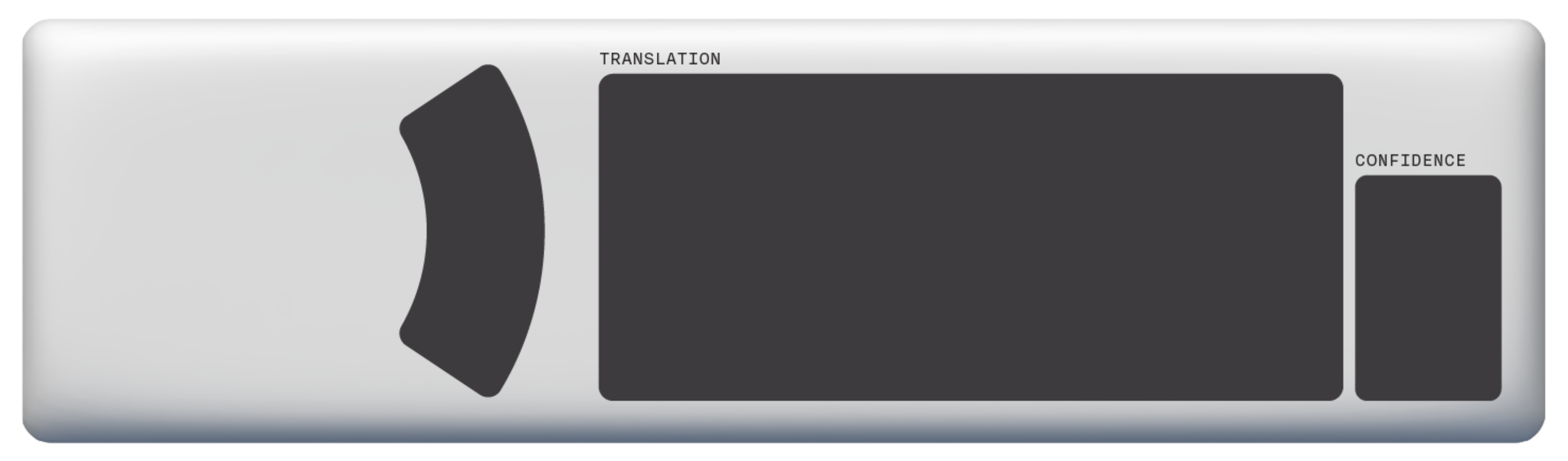
The Whale Relic emerges from this work. It is not a translator that explains, but an instrument that listens. Each point of light within it is drawn from an actual recording—a coda that once rippled through the waters off Dominica or the Galápagos. When activated, it plays the original sound and produces an imagined human response: Recognition, Gathering, Unknown Signal. The brightness of each glyph shifts with the model’s confidence, echoing how our algorithms test their own understanding. It is a conversation that never resolves, a translation machine that knows its limits. Some signals are stable, others blur or dissolve entirely. The Relic shows not what we know, but what we are still learning to hear.
To translate whales is not to decode them; it is to meet them in uncertainty. The ethical act is to listen before speaking. Understanding here is a spectrum, not a destination. The Relic captures that gradient—the threshold between data and empathy, between sound and sense. Each pulse of light becomes a hypothesis about connection, each click a small act of care.
Perhaps, as when Roger and Katy Payne first recorded whale songs in the 1970s, a new wave of empathy begins here—not from what we understand, but from what we finally learn to hear. To translate another species is to learn humility at the scale of the planet. What we learn from whales is not their language, but our own capacity to listen.
Dive into the hidden language of whales. Select a conversation type on the left of the translation module and listen as clicks and codas ripple through the deep seas.
The module is still in development, and some codas can only be partially interpreted. The confidence meter hints at how closely our understanding captures the patterns of their communication.
David Gruber
David Gruber is the Founder & President of Project CETI (Cetacean Translation Initiative), a nonprofit, interdisciplinary scientific and conservation initiative on a mission to listen to and translate the communication of sperm whales. He is a Distinguished Professor of Biology and Environmental Sciences at the City University of New York, Baruch College & The CUNY Graduate Center. His interdisciplinary research bridges animal communication, climate science, marine biology, microbiology, molecular biology and his inventions include technology to perceive the underwater world ("shark-eye camera") from the perspective of marine animals.
Giovanni Petri
Giovanni Petri is a Professor in the Network Science Institute at Northeastern University London. His research spans the analysis of neuroimaging data and AI systems with topological techniques, the formalization of cognitive control models with tools of statistical mechanics and network theory, and the study of the predictability of socio-technical systems.
Lorem ipsum dolor sit amet, consectetur adipisicing elit. Necessitatibus nulla, at culpa animi aut facilis reiciendis voluptate ratione cupiditate qui perspiciatis, assumenda nostrum saepe deserunt quia veniam accusantium error suscipit!






Select a category to begin.
